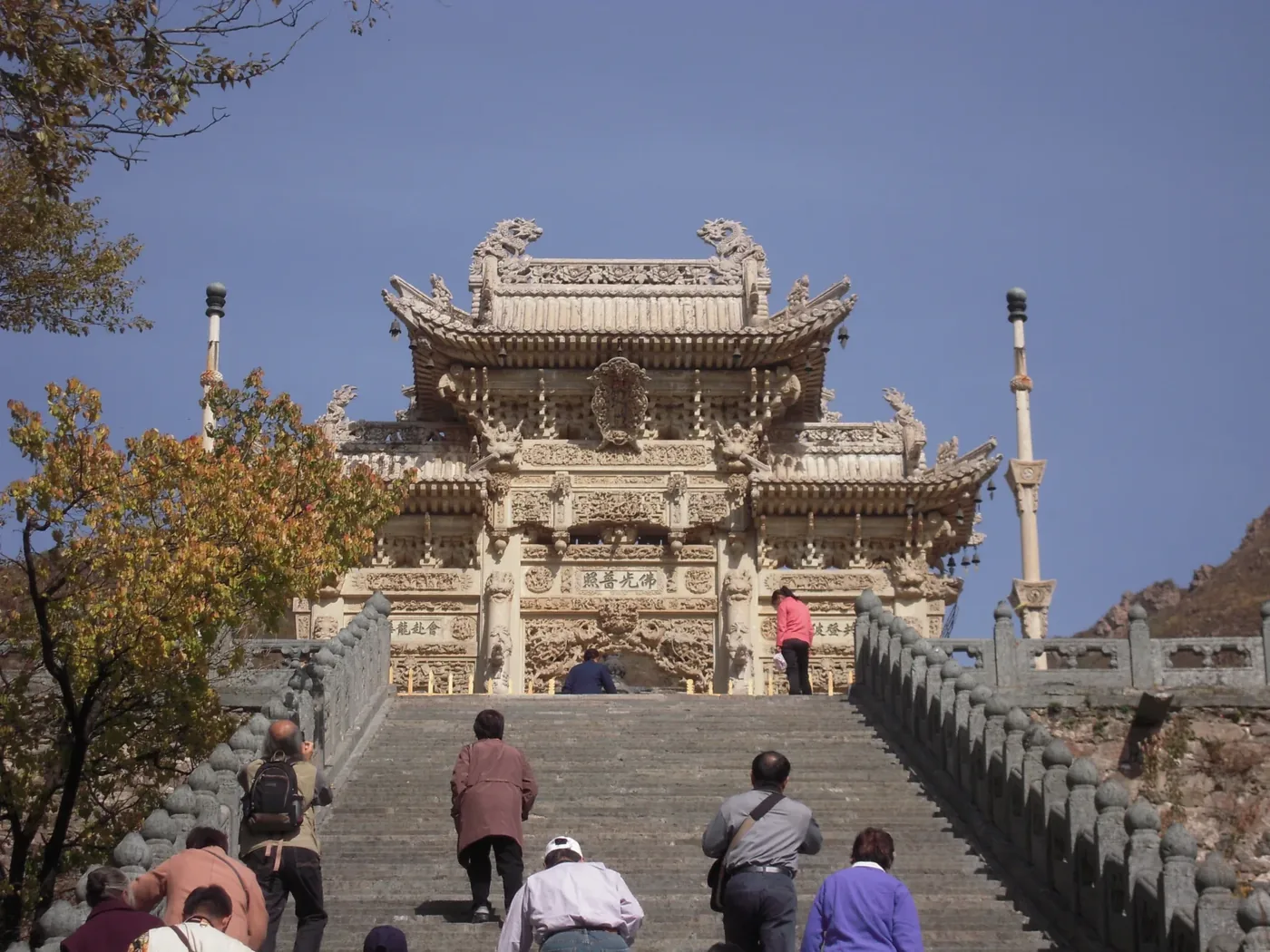
Written and fact-checked by: Rocket Zheng
Last verified:
Quick Answer
Wutai Mountain is worth visiting if you are interested in Chinese Buddhism, sacred mountains, temple culture and a deeper religious landscape than a normal sightseeing attraction.
It is best for:
- Buddhist culture;
- Manjushri worship;
- temple architecture;
- Han Chinese and Tibetan Buddhist traditions in one place;
- a 2–3 day cultural journey in Shanxi.
It is not ideal if you want dramatic natural scenery like Zhangjiajie or Huangshan, a simple day trip from a major city, or a warm-weather destination all year.
For a first visit, the best route is:
Day 1: Shuxiang Temple → Wuye Temple → Tayuan Temple → Xiantong Temple → Pusa Ding → evening walk in Taihuai Town
Day 2: Dai Luoding “small pilgrimage” → Luohou Temple or Nanshan Temple → leave in the afternoon
One day is possible but rushed. Three days are better if you want to add sunrise at East Terrace or visit more temples slowly.
What Makes Wutai Mountain Different?
The most important thing to understand is this:
Wutai Mountain is not one mountain trail. It is a Buddhist mountain region.
The practical center of the trip is Taihuai Town, a high-altitude town surrounded by the five terraces. Most first-time visitors stay here and visit temples on foot or by short local transport.
The name “Wutai” means “Five Terraces.” These are the five flat-topped peaks surrounding the area:
| Terrace | Chinese Name | Approx. Elevation | Common Meaning |
|---|---|---|---|
| East Terrace | Wanghai Peak | 2,795 m | Popular for sunrise |
| West Terrace | Guayue Peak | 2,773 m | One of the pilgrimage terraces |
| South Terrace | Jinxiu Peak | 2,485 m | Lowest of the five |
| North Terrace | Yedou Peak | 3,061 m | Highest peak in North China |
| Central Terrace | Cuiyan Peak | 2,894 m | Central pilgrimage terrace |
Most temples that ordinary visitors see are not on top of these terraces. They are concentrated in and around Taihuai Town, at about 1,700 meters above sea level.
This is why many visitors should not think of Wutai Mountain as “climbing a mountain.” The normal first-time trip is a temple route. The full Five Terraces pilgrimage is a separate and much harder journey.
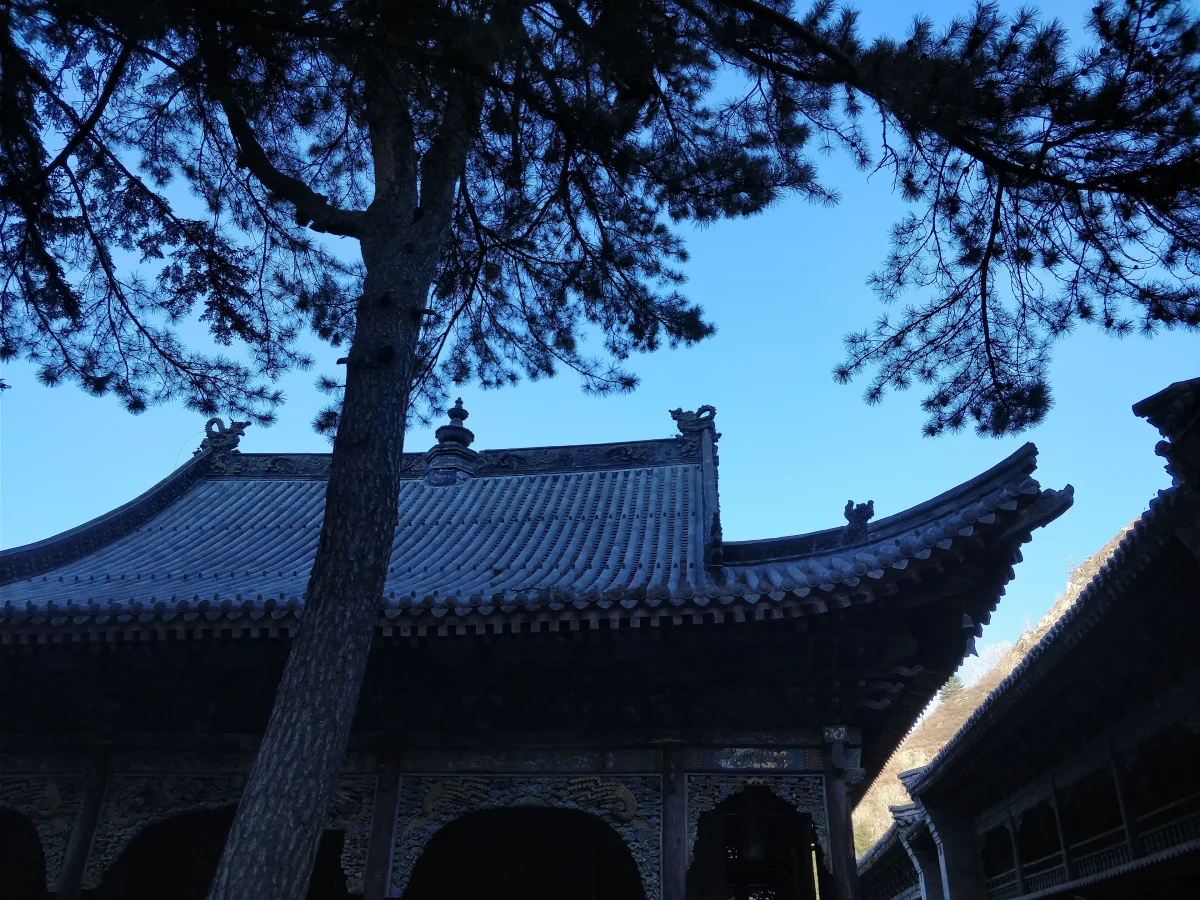
Wutai Mountain, Taihuai Town and Wutai Mountain Station
Foreign visitors often get confused by the names.
| Name | What It Means |
|---|---|
| Wutai Mountain / Wutaishan | The whole scenic and religious mountain region |
| Taihuai Town | The main visitor base inside the scenic area |
| Wutai County | The county-level administrative area; not the same as the temple center |
| Xinzhou | The prefecture-level city that administers the area |
| Taiyuan | Shanxi’s provincial capital and the most common transport hub |
| Datong | A northern Shanxi city often combined with Yungang Grottoes |
| Wutai Mountain Station / Shahe Station | A normal-speed railway station about 48 km from Taihuai Town; not a high-speed station |
| Wutai Mountain Airport | A regional airport with limited flights, mainly useful in some travel seasons |
The actual destination for most foreign visitors is Taihuai Town.
Do not assume that “Wutai Mountain Station” is beside the temples. It is not. You still need a transfer of roughly 1.5–2 hours from the station area to Taihuai Town.
How Many Days Do You Need?
One Day
One day is possible, but rushed. Stay inside Taihuai Town and focus on the main temples:
Shuxiang Temple → Wuye Temple → Tayuan Temple → Xiantong Temple → Pusa Ding
Do not try to add the Five Terraces on the same day.
Two Days
Two days are best for most foreign visitors.
You can see the main temples on Day 1, stay overnight in Taihuai Town, then visit Dai Luoding on Day 2 for the symbolic “small pilgrimage.” This gives you enough time to understand the place instead of just taking photos of the White Stupa.
Three Days
Three days are good if you want a slower route, more temples, or a sunrise trip to East Terrace. A three-day trip can include the core temples, Dai Luoding, Nanshan Temple or Luohou Temple, evening atmosphere in Taihuai Town, and one terrace viewpoint if weather and transport are arranged in advance.
Full Five Terraces Pilgrimage
The full Five Terraces route is not a normal sightseeing route.
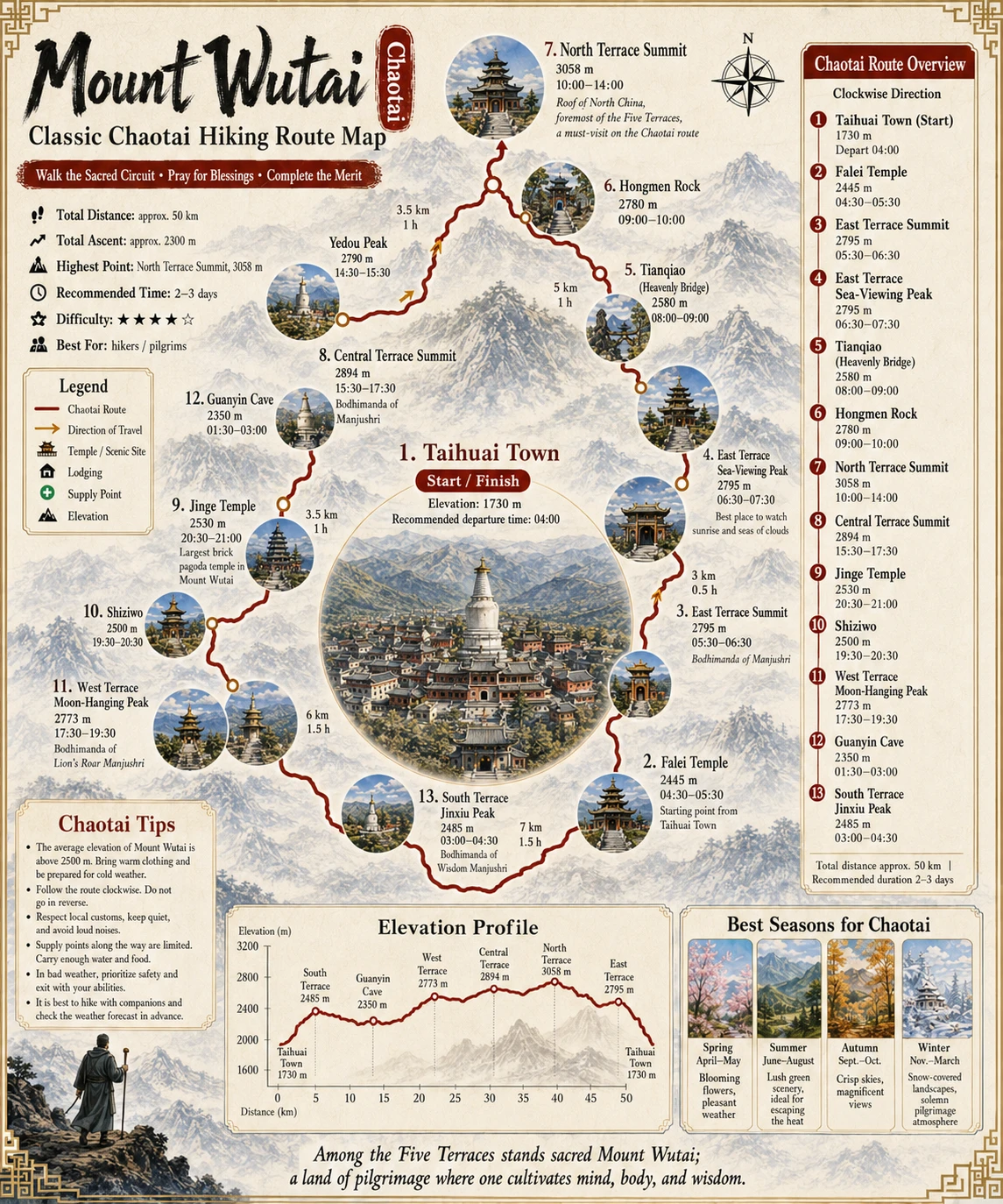
It is usually a 2–3 day pilgrimage or outdoor route of a little over 50 km, with major elevation gain, high-altitude weather, strong wind and limited services. It is not recommended for ordinary first-time foreign visitors without preparation.
Best 2-Day Route for First-Time Visitors
Day 1: Core Temples in Taihuai Town
Start with Shuxiang Temple, which is closely connected with Manjushri worship. Then continue to Wuye Temple, one of the busiest incense sites in Wutai Mountain. From there, visit Tayuan Temple and its famous Great White Stupa, then Xiantong Temple, one of the oldest and most important temples in the area. End with Pusa Ding, which sits above the town and has a different Tibetan Buddhist and imperial-style atmosphere.
Suggested order:
- Shuxiang Temple
- Wuye Temple
- Tayuan Temple
- Xiantong Temple
- Pusa Ding
- Evening walk in Taihuai Town
This day is not physically hard, but you will walk a lot and climb some steps.
Day 2: Dai Luoding and Optional Extra Temples
On the second day, visit Dai Luoding. It is called the “small pilgrimage” because it symbolically brings together the worship of Manjushri from all five terraces in one accessible place.
You can climb the 1,080 steps or take the cable car if available. After Dai Luoding, add Luohou Temple or Nanshan Temple if you have time and energy.
This route gives normal travelers a real sense of Wutai Mountain without requiring professional hiking.
Main Temples to Visit
Xiantong Temple
Xiantong Temple is one of the most important temples in Wutai Mountain. It is often described as one of the oldest and largest temples in the region, and it is a key place for understanding the historical depth of Wutai Mountain.
It has important halls, old architecture and a serious temple atmosphere. It is also easy to combine with Tayuan Temple and Pusa Ding.
Recommended time: 1–1.5 hours
Difficulty: Easy
Best for: history, architecture, understanding Wutai Mountain’s depth
Ticket note: Separate temple ticket: RMB 10
Tayuan Temple and the Great White Stupa
Tayuan Temple is famous because of the Great White Stupa, the most recognizable landmark in Wutai Mountain.
The stupa is tall, white and visible from many places around Taihuai Town. Many pilgrims walk clockwise around the stupa. If you join or walk nearby, follow the same clockwise direction and avoid interrupting worshippers.
Recommended time: 30–60 minutes
Difficulty: Easy
Best for: landmark photos, Buddhist atmosphere, orientation in Taihuai Town
Ticket note: Separate temple ticket: RMB 10
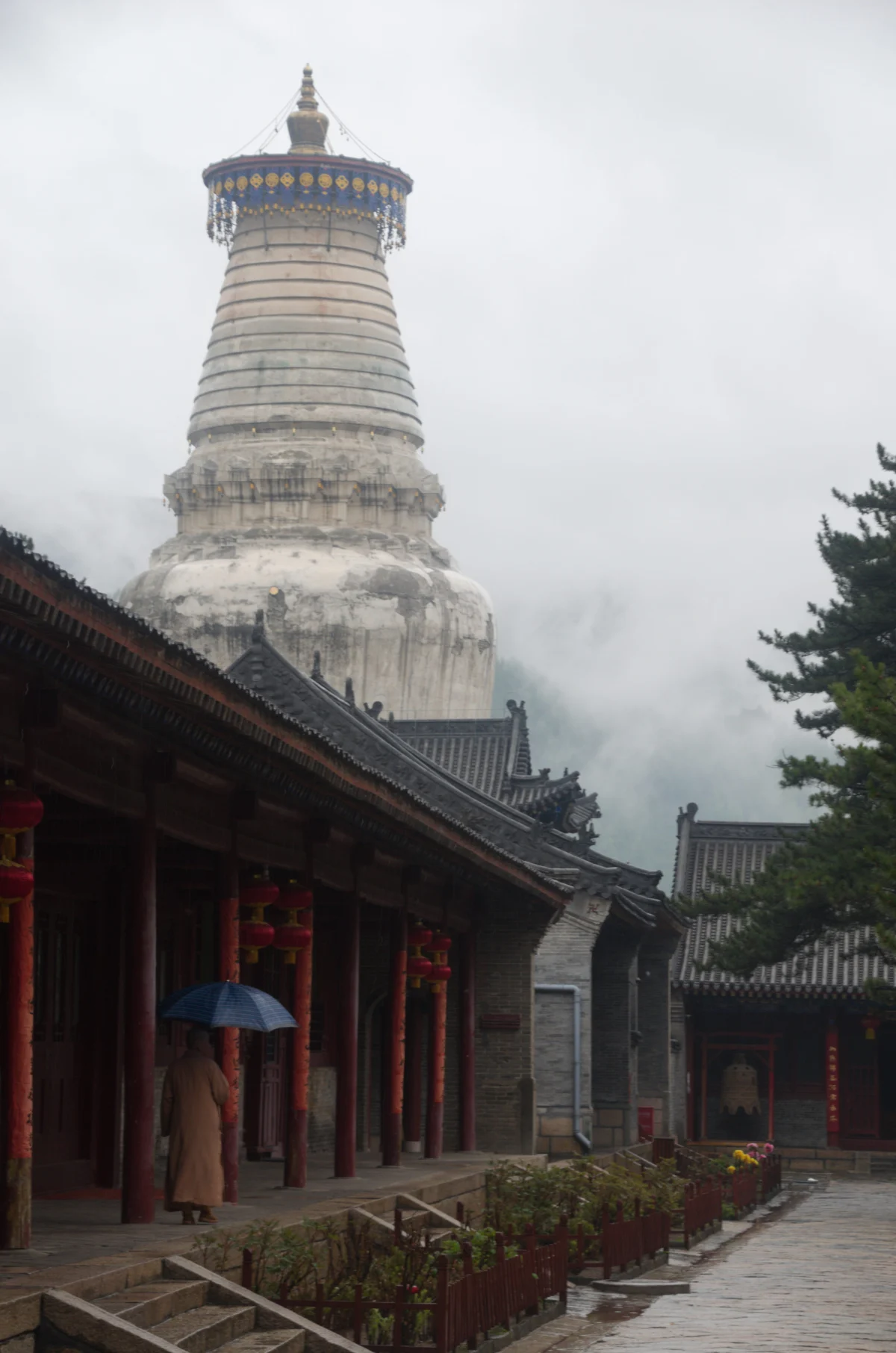
Pusa Ding
Pusa Ding is one of the most distinctive temples in Wutai Mountain. It is the largest Tibetan Buddhist temple in the area and has strong imperial associations from the Qing dynasty.
The yellow glazed tiles and elevated position give it a different feeling from many Han Chinese temples in Taihuai Town. The climb is not long, but the steps are steep. In winter or after snow, they can become slippery.
Recommended time: 45–60 minutes
Difficulty: Moderate because of the steps
Best for: Tibetan Buddhist atmosphere, imperial history, views over Taihuai Town
Not ideal for: travelers with weak knees in icy weather
Ticket note: Separate temple ticket: RMB 10
Shuxiang Temple
Shuxiang Temple is one of the best places for foreign visitors to understand why Wutai Mountain is associated with Manjushri.
It is especially relevant if you want to understand Wutai Mountain as a wisdom-related Buddhist sacred place rather than just a collection of old buildings.
Recommended time: About 1 hour
Difficulty: Easy
Best for: Manjushri worship, first-time understanding of Wutai Mountain
Ticket note: Included in the main scenic ticket
Wuye Temple
Wuye Temple is one of the busiest and most popular temples in Wutai Mountain. It is famous for strong incense activity and local folk belief.
Foreign visitors should not over-mystify it. It is best understood as a place where folk religion and Buddhist mountain culture meet. It gives you a useful window into how Chinese religious practice often works in real life: prayer, incense, wishes, donations and crowds.
Incense, offerings and donations should be voluntary. Do not accept incense from strangers if you are unsure whether payment will be demanded later.
Recommended time: 30–45 minutes
Difficulty: Easy
Best for: observing living religious practice
Crowd level: Often busy, especially on holidays
Ticket note: Included in the main scenic ticket
Dai Luoding
Dai Luoding is one of the most important stops for ordinary visitors because it offers the “small pilgrimage” experience.
The full Five Terraces pilgrimage is difficult and time-consuming. Dai Luoding makes the idea more accessible: by climbing to this temple, visitors symbolically worship the five forms of Manjushri without going to all five terraces.
There are 1,080 steps on the main stair route. Fit visitors can walk up in around 40–70 minutes. Older travelers, children or anyone with knee problems may prefer the cable car if it is running.
Recommended time: 1.5–2.5 hours
Difficulty: Moderate if walking; easier with cable car
Best for: symbolic pilgrimage, first-time visitors, views and religious context
Ticket note: Separate temple ticket: RMB 8; cable car costs extra
Dai Luoding and the “Small Pilgrimage”
The full pilgrimage, sometimes called the “great pilgrimage,” means visiting all five terraces: East, West, South, North and Central. This is a serious pilgrimage or outdoor route.
The small pilgrimage at Dai Luoding is a symbolic version. Instead of going to all five terraces, pilgrims visit Dai Luoding, where the five Manjushri forms are represented together.
For most foreign visitors, Dai Luoding is the better choice.
It is meaningful, realistic and possible within a normal 2-day trip. It gives you a sense of the Five Terraces tradition without requiring multi-day hiking, high-altitude exposure or complex transport.
Should You Hike the Five Terraces?
Most first-time foreign visitors should not attempt the full Five Terraces route casually.
The complete route is a little over 50 km and can take 2–3 days on foot. It involves high altitude, long distances, large elevation changes, strong wind and quickly changing weather. North Terrace reaches over 3,000 meters and is the highest point in North China.
There are also special vehicles for terrace visits in some seasons, but routes, schedules and access can depend on weather, road conditions and regulations.
The most important point:
Do not treat the Five Terraces as a normal sightseeing loop.
If you are an experienced hiker or a serious Buddhist pilgrim, research it separately, prepare proper gear and consider local assistance. If you are a first-time visitor with normal travel goals, visit Dai Luoding instead.
How to Get to Wutai Mountain
From Taiyuan
Taiyuan is usually the best transport hub for foreign visitors.
The most practical option is the long-distance bus from Taiyuan’s eastern long-distance bus station toward Wutai Mountain / Taihuai Town. It usually has more frequent departures than smaller transfer points and is easier than combining several local routes.
Another option is:
Taiyuan South Station → Xinzhou West Station → transfer to Taihuai Town
This can work if the connection from Xinzhou West is available, but schedules should be checked in advance.
From Datong
Datong can be combined with Wutai Mountain, especially if you are visiting Yungang Grottoes or doing a wider Shanxi route.
Travel from Datong to Wutai Mountain usually takes around 3–4 hours by long-distance bus or car. Some sections include mountain roads, so do not treat it as a short city transfer.
From Beijing
Beijing to Wutai Mountain is possible, but it is not the smoothest route for first-time foreign visitors.
A common plan is:
Beijing → Taiyuan South by high-speed rail → bus to Wutai Mountain
Another option is Beijing to Xinzhou West, then transfer to Taihuai Town, depending on available trains and local transport.
Wutai Mountain Station Warning
Wutai Mountain Station, also known as Shahe Station, is not beside the temple area.
It is a normal-speed railway station about 48 km from Taihuai Town. After arriving, you still need a bus or car transfer that may take around 1.5–2 hours.
This is one of the easiest mistakes for foreign visitors to make.
Getting Around Wutai Mountain
Taihuai Town is the center of the normal visitor experience. Many core temples are close enough to visit on foot, especially if your hotel is well located.
There are also local buses and scenic transport options inside the area. A sightseeing bus ticket may be available and valid for multiple days. Taihuai Town’s core area also has local buses that help visitors move between temple areas.
For Dai Luoding, you can reach the lower area by local bus or scenic transport, then walk up the steps or use the cable car if operating.
For the Five Terraces, ordinary walking around Taihuai Town is not enough. You need a dedicated vehicle, special terrace transport or a prepared hiking route.
Self-driving rules can be strict in peak seasons, with vehicle reservation systems and traffic restrictions. Foreign visitors using private cars should check current rules before arrival.
Tickets, Passport and Payment Notes
As of 2026, Wutai Mountain uses a main scenic area ticket. Many core temples are included, but four major stops on the standard first-time route have separate temple tickets:
- Xiantong Temple: RMB 10;
- Tayuan Temple: RMB 10;
- Pusa Ding: RMB 10;
- Dai Luoding: RMB 8.
Additional transport or site-specific charges can still apply for:
- Dai Luoding cable car;
- Five Terraces transport;
- some outer temples such as Foguang Temple and Nanchan Temple.
Wutai Mountain uses a real-name reservation system. The official online system is mainly designed around Chinese mainland ID cards. Foreign passport holders may not be able to complete the same online process smoothly.
Foreign visitors should bring the original passport and be prepared to buy tickets or complete checks at the visitor service center or staffed ticket windows.
For payment, Alipay or WeChat Pay linked to an international card is the most convenient. Bring a small amount of cash as backup, especially for small vendors, donations or places where digital payment does not work smoothly.
Credit cards such as Visa or Mastercard are not widely useful in small shops, though larger hotels may accept them.
Where to Stay
Taihuai Town
Taihuai Town is the best base for most foreign visitors.
You can walk to many core temples, experience the evening atmosphere and avoid wasting hours commuting from a distant city.
Stay here if:
- it is your first visit;
- you want to see the main temples properly;
- you want an easier 2-day route;
- you want to visit Dai Luoding;
- you want to experience Wutai Mountain after day-trippers leave.
Hotel quality varies. For foreign visitors, the practical issue is passport registration. Larger hotels and properties listed clearly on international booking platforms are usually safer choices. If booking a small guesthouse, confirm in advance that they can register a foreign passport.
Taiyuan, Datong or Xinzhou
Taiyuan has more hotels and transport connections, but it is too far for a relaxed day trip. It works better as an arrival or departure hub.
Datong is useful if you are doing a wider Shanxi trip with Yungang Grottoes or other northern Shanxi sites, but it is still several hours away.
Xinzhou can be a practical transfer point, especially with high-speed rail, but it is not as meaningful as Taihuai Town for the actual visit.
Difficulty, Altitude and Physical Reality
Wutai Mountain has two very different difficulty levels.
Taihuai Town Core Temples
This is easy.
Most main temples are in or around Taihuai Town. The area is high in altitude, but the walking itself is not difficult. It is suitable for most travelers, including older visitors and families, as long as they can handle normal walking and some stairs.
Pusa Ding and Dai Luoding
Pusa Ding has a short but steep stair climb. Dai Luoding has 1,080 steps if you walk up. These are moderate, not extreme.
Dai Luoding is manageable for fit visitors, but it can be tiring for older travelers, children or anyone with knee problems. Use the cable car if needed.
Five Terraces
The Five Terraces are difficult.
They involve high altitude, long routes, strong wind and cold conditions. North Terrace is over 3,000 meters, and some visitors may feel mild altitude effects such as headache or fatigue.
Do not compare this with a casual temple walk.
Best Time to Visit and Weather
Summer
Summer is the most comfortable season for many visitors. Wutai Mountain is much cooler than Taiyuan, Beijing or Datong, and it has long been known as a cool mountain area.
However, summer is also busy, especially during school holidays and Buddhist pilgrimage periods.
Bring warm layers even in summer, especially if you plan to go to the terraces.
Autumn
Early autumn can be very good, especially September and early October before or after major holiday crowds.
The weather is cooler and often clearer, but National Day Golden Week can be extremely crowded.
Winter
Winter can be beautiful but difficult.
Snow scenery can be quiet and powerful, but temperatures can be extremely low, roads to the terraces may be closed, restaurants and guesthouses may reduce operations, and icy steps can be dangerous.
For ordinary first-time visitors, winter is only recommended if you are prepared for cold conditions and accept limited access.
Important Seasonal Warning
The roads to the Five Terraces are commonly closed from around November to the end of April, and terrace transport stops during this period. Even in April, snow and ice may remain on high sections.
Food and Supplies
Taihuai Town has restaurants, small shops and basic supplies, but do not expect a large city.
Food is mostly local Shanxi-style, including noodles and other northern Chinese dishes. Vegetarian food is also relatively easy to find because this is a Buddhist area.
Prices can be higher than in Taiyuan or other cities because this is a scenic religious area.
Bring water, snacks, small cash, warm clothing, any medicines you need, and Chinese names or screenshots for your hotel and key temples.
Do not rely on finding coffee or Western food. This is a Buddhist mountain town, not an international resort.
Temple Etiquette for Foreign Visitors
Wutai Mountain is an active religious destination, not just a sightseeing park.
Basic etiquette:
- keep your voice low inside temples;
- do not step on temple thresholds;
- do not photograph Buddha statues, rituals, monks or worshippers unless clearly allowed;
- follow “no photography” signs immediately;
- move clockwise when walking around stupas or prayer areas;
- do not interrupt worshippers;
- incense, offerings and donations should be voluntary;
- do not accept incense from strangers if you are unsure whether payment will be requested later;
- in Tibetan Buddhist areas, turn prayer wheels clockwise and do not disturb lamas.
You do not need to understand every ritual. Respectful distance and quiet behavior are usually enough.
Common Mistakes
1. Thinking Wutai Mountain is one temple
It is not. It is a large Buddhist mountain region with many temples and five surrounding terraces.
2. Thinking Wutai Mountain is easy as a day trip from Taiyuan or Datong
The road transfer can take several hours each way. A same-day trip is possible only if you accept a rushed visit.
3. Confusing Wutai Mountain Station with the scenic area
Wutai Mountain Station is still far from Taihuai Town. You need another transfer.
4. Not confirming whether your hotel accepts foreign passports
Some small accommodations may not be familiar with foreign passport registration. Confirm before booking.
5. Underestimating the cold
Wutai Mountain is much colder than nearby cities. The terraces can be cold even in summer.
6. Treating the full Five Terraces pilgrimage as normal sightseeing
It is not. It is a serious pilgrimage or outdoor route.
7. Only taking photos of the Great White Stupa
The White Stupa is beautiful, but Wutai Mountain is about the temple region as a whole.
8. Visiting during a holiday without booking ahead
Major Chinese holidays and Buddhist festival periods can create heavy crowds and hotel shortages.
9. Taking photos inside temple halls without checking
This can cause problems. When in doubt, do not photograph inside halls.
10. Accepting incense or “help” from strangers
This can lead to pressure to pay. Keep offerings and donations voluntary.
Final Recommendation
Wutai Mountain is one of the best Buddhist mountain destinations in China for travelers who want depth rather than simple sightseeing.
It is not the easiest Buddhist site, and it is not the most visually dramatic mountain. Its value lies in the concentration of temples, the Manjushri tradition, the coexistence of Han Chinese and Tibetan Buddhism, the high-altitude setting and the special idea of the Five Terraces pilgrimage.
For most foreign visitors, the best plan is simple:
Stay in Taihuai Town for one night, visit the main temples, climb or take the cable car to Dai Luoding, and do not rush into the full Five Terraces route unless you are properly prepared.
If Mount Putuo is a peaceful Buddhist island, and Mount Emei is a large Buddhist mountain journey, Wutai Mountain is a living highland Buddhist world. Give it time, dress warmly, bring your passport, respect the temples and avoid treating it as just another scenic mountain.
FAQ
Is Wutai Mountain worth visiting for foreign visitors?
Yes, if you are interested in Buddhist culture, sacred mountains and a deeper religious landscape. It is not the best choice if you only want dramatic natural scenery.
How many days do I need for Wutai Mountain?
Two days are best for most first-time visitors. One day is possible but rushed. Three days are better if you want more temples or a terrace visit.
Where should I stay?
Stay in Taihuai Town. It is the practical center for visiting the main temples and experiencing the atmosphere of Wutai Mountain.
Is Wutai Mountain hard to visit?
The core temple area in Taihuai Town is not hard. Dai Luoding is moderate if you climb the steps. The full Five Terraces pilgrimage is difficult and not recommended for unprepared first-time visitors.
Can foreign visitors buy tickets with a passport?
Foreign passport holders should bring the original passport and use staffed ticket windows or the visitor service center if online systems do not accept foreign passport details smoothly.
Is Wutai Mountain cold in summer?
It can be cool, especially in the morning and evening. The terraces are much colder than Taihuai Town. Bring warm layers even in summer.
Can I visit Wutai Mountain from Taiyuan in one day?
It is possible but rushed. For a better experience, stay at least one night in Taihuai Town.
Is Dai Luoding worth visiting?
Yes. For ordinary foreign visitors, Dai Luoding is the most realistic way to experience the idea of the Five Terraces pilgrimage.
Should I do the full Five Terraces pilgrimage?
Only if you have proper preparation, fitness, gear and time. It is not a casual sightseeing route.
Image Credits
Puhua Temple in Mount Wutai, picture2 by Huangdan2060, via Wikimedia Commons, licensed under CC0 1.0 . Resized/compressed from original.
中國山西五台山世界遺產S440 by 林高志, via Wikimedia Commons, licensed under CC BY-SA 4.0 . Resized/compressed from original.
Wutai shan Chorten by Popolon, via Wikimedia Commons, licensed under CC BY-SA 4.0 . Resized/compressed from original.
Related guides
Mount Putuo Travel Guide: Ferry, Tickets, Temples and Foreign Visitor Tips
A practical Mount Putuo guide for foreign visitors: how to reach Putuoshan by ferry, how tickets and passports work, what to see, where to stay, Buddhist temple etiquette, typhoon risks, and the best first-time routes.
Best Buddhist Mountains in China for Foreign Visitors
Compare the most practical Buddhist mountain journeys in China, including island pilgrimage sites, temple mountain regions, and Shaolin-related routes.